Enhancing Role-Play Learning with Vegan Gluten Free Tinned Food Labels F
In the evolving landscape of early childhood education and home-based learning, the tools we provide for imaginative play are just as critical as the curriculum itself. Among the myriad of resources available, Vegan Gluten Free Tinned Food Labels F stands out as a specialized asset designed to bridge the gap between creative role-play and practical life skills. This collection is not merely a set of decorative stickers; it is a carefully curated educational resource that supports dietary awareness, literacy, and numeracy in childcare settings, schools, and homes.
For educators, childminders, and parents who prioritize inclusive and health-conscious environments, these labels offer a unique opportunity to simulate real-world shopping and cooking scenarios without the allergens or ethical concerns associated with traditional toy food items. By integrating realistic packaging design with accurate nutritional data, this product transforms simple cardboard tubes into powerful teaching aids.
Understanding the Design and Educational Value
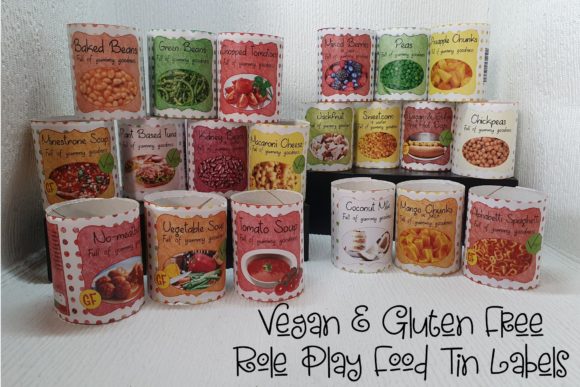
The core concept behind Vegan Gluten Free Tinned Food Labels F is simplicity paired with depth. The labels are designed to fit around standard toilet roll tubes that have been cut in half, providing an eco-friendly and cost-effective base for "tins." This approach encourages sustainability by upcycling household waste, a lesson in itself for young learners. However, the true value lies in the content printed on each label.
Each label features a detailed ingredients list and nutritional information based on real products. This attention to detail is crucial for several reasons. First, it introduces children to the concept of reading labels, a vital life skill. Second, by focusing on vegan and gluten-free options, it reflects modern dietary trends and restrictions, ensuring that role-play scenarios are inclusive of children with specific dietary needs or ethical choices. The inclusion of Curriculum for Excellence learning outcomes in the download further underscores its utility in formal educational settings, offering teachers a ready-made framework for integrating these materials into lessons on health, social studies, and language.
Comparing Formats: Digital Flexibility vs. Physical Durability
When evaluating resources like Vegan Gluten Free Tinned Food Labels F, it is important to consider the format in which they are delivered. This product comes as a comprehensive digital package, including 20 JPG sheets with five identical labels per page, a PDF version for easy printing, four JPG sheets with one label per product, and 20 individual high-resolution JPGs. This variety addresses different user needs and technical capabilities.
The multi-label sheets are ideal for bulk printing when setting up a large classroom shop or a busy home play area. They maximize paper efficiency and reduce printing time. Conversely, the single-label sheets and individual JPGs offer flexibility for those who wish to enlarge specific labels for group discussions or visual aids. For instance, a teacher might project an enlarged label onto a whiteboard to guide a class through identifying sugars or salts in a diet, leveraging the high-resolution files for clarity.
However, users must weigh the trade-offs of digital downloads. Unlike pre-made plastic toys, these labels require assembly. While this can be a collaborative activity with older children, it demands time and effort from the adult preparer. The need for a printer, ink, and potentially cardstock adds to the initial setup cost, though it remains significantly cheaper than purchasing commercial pretend food sets. Furthermore, paper labels are less durable than plastic alternatives unless laminated or printed on heavy card, which is a consideration for high-traffic childcare environments.
Practical Application and Assembly Techniques
The effectiveness of Vegan Gluten Free Tinned Food Labels F depends largely on how well they are assembled. The creator recommends using toilet roll tubes cut in half, noting that a sharp knife yields cleaner cuts than scissors, which can squash the tube. This practical tip highlights the hands-on nature of the resource. For those seeking a more polished look or greater durability, printing onto card and rolling it into a tube shape is a viable alternative. This method eliminates the reliance on found objects and allows for uniform sizing, which can be important for stacking and organizing during play.
In practice, these labels can be used in diverse ways. In a home setting, they can facilitate a grocery shopping game where children must select items based on dietary restrictions, such as finding only gluten-free options. In a school environment, they can support mathematics lessons through pricing and budgeting exercises, or science lessons by discussing food groups and nutrition. The realistic design helps suspend disbelief, allowing children to engage more deeply with the scenario.
Evaluating Fit: When to Choose This Resource
Deciding whether Vegan Gluten Free Tinned Food Labels F is the right choice for your setting requires assessing your specific goals and constraints. This resource is particularly well-suited for:
- Educators focusing on health and nutrition: The detailed nutritional information provides authentic material for lessons on healthy eating.
- Inclusive childcare providers: The vegan and gluten-free focus ensures that no child feels excluded due to dietary restrictions during play.
- Budget-conscious families and schools: Using recycled tubes and printable labels is far more economical than buying proprietary toy food.
- Environmentally conscious users: The upcycling aspect aligns with sustainability goals and teaches children about reusing materials.
Conversely, this may not be the best option if you require immediate, zero-prep solutions. If your setting lacks access to a reliable printer or if you prefer the durability of hard plastic toys that can withstand rough handling without lamination, commercial alternatives might be more appropriate. Additionally, if your curriculum does not emphasize dietary specifics, the niche focus on vegan and gluten-free products might feel restrictive compared to generic food labels.
Learning Opportunities Across the Curriculum
The versatility of Vegan Gluten Free Tinned Food Labels F extends beyond simple pretend play. The included overview of Curriculum for Excellence learning outcomes highlights how these labels can support development in multiple areas. For example, reading ingredients lists enhances literacy and vocabulary, while comparing nutritional values fosters numeracy and data interpretation skills. Socially, role-playing shopping scenarios encourages communication, cooperation, and understanding of community roles.
Moreover, the realistic nature of the labels allows for deeper discussions about food sources, ethical consumption, and health. Children can learn why certain products are labeled vegan or gluten-free, fostering empathy and awareness of diverse lifestyles. This contextual learning is often more impactful than abstract instruction, as it embeds knowledge in meaningful, playful experiences.
Making an Informed Decision
Ultimately, Vegan Gluten Free Tinned Food Labels F represents a thoughtful intersection of creativity, education, and inclusivity. It challenges the notion that educational resources must be expensive or commercially produced to be effective. By providing high-quality, realistic designs in a flexible digital format, it empowers adults to create customized learning environments that reflect contemporary values.
Before downloading, consider your capacity for preparation and your specific educational objectives. If you value sustainability, inclusivity, and hands-on learning, and are willing to invest time in assembly, this collection offers significant benefits. It transforms everyday waste into engaging tools that promote literacy, numeracy, and social skills. However, if durability and convenience are your primary concerns, you may need to supplement these labels with protective measures like lamination or consider more robust commercial alternatives. Regardless of your choice, the emphasis on realistic, health-conscious play remains a valuable trend in modern early years education.